20 Team Building Games for Work That Don’t Feel Forced


Looking for team-building exercises that are fun without feeling forced? We speak to a lot of organisers who run these kinds of games, and we know they can be a great way to take a break from the daily routine and get colleagues talking about things outside of work. But team-building activities can easily feel awkward or forced, especially when the only activity you do is a big event, like an escape room, once a year.
If your colleagues aren’t used to socialising together outside of work, jumping straight into a big organised activity can feel like a lot. That’s why it’s worth mixing things up. Run quick icebreakers during meetings or on Fridays, keep one or two low-effort competitions going throughout the year, and save the bigger activities for once or twice a year. That way, team building becomes a regular part of spending time together, rather than one big event everyone has to get excited about.
Below is a full list of games in each category, plus real insights from the people inside companies who actually organise this stuff.
Quick team building exercises (5 minutes or less)
These are the easiest ways to fill a Friday afternoon or at the start of a meeting.
Wavelength Game
One person closes their eyes while everyone else picks a number from 1-10 that represents where they sit on a scale: "spiciness of a pizza topping," "commonness of a boy’s name" (e.g. John vs Auberon) "how relaxing a holiday destination is." The guesser asks a category and everyone answers with their pick. It reveals a surprising amount about how differently people think.
Whose Secret is That
Everyone writes two "secrets" or fun facts about themselves on a slip of paper and drops them in a bowl. Read them out one at a time and get the group to guess whose is whose. It works well for teams who don't know each other that well yet.
Guess Who
Write down names of celebrities, famous characters, objects, animals or even of each other and stick them on people’s foreheads or show it to everyone but one person. The guesser has to ask yes or no questions until they get it. You can also do it as a competition (eg: 2 people from different teams) and see who gets it first.
Pictionary
You can play this online or in person at the start of a meeting to get everyone energised and in a good mood.
Imposter
One version: everyone says a single word related to a secret word, and the imposter (who doesn't know the word) has to bluff along. Another version: pick a place, and everyone takes turns asking yes/no questions to one person like "would you take your dog here?" or "would you go here on a first date?". The group votes for who they think the imposter is based on the answers.
Category Countdown
Pick a category, "countries beginning with S," for example, and go around the circle. Each person names something that hasn't already been said. Hesitate for more than three seconds and you're out. Continue until there is only one person left. It’s simple, competitive, and it always runs longer than you'd think.
Secret Missions
At the start of an evening or event, give everyone a private mission to complete without anyone noticing: "get someone to say the word 'banana' in a normal sentence," "convince someone to swap seats with you twice”. If you’re caught trying to complete a mission, you’re out!
Team building games you can run all year round
If you want to keep people engaged for months and give them something easy to talk about, you can create year-round competitions with an ongoing leaderboard.
Last Man Standing
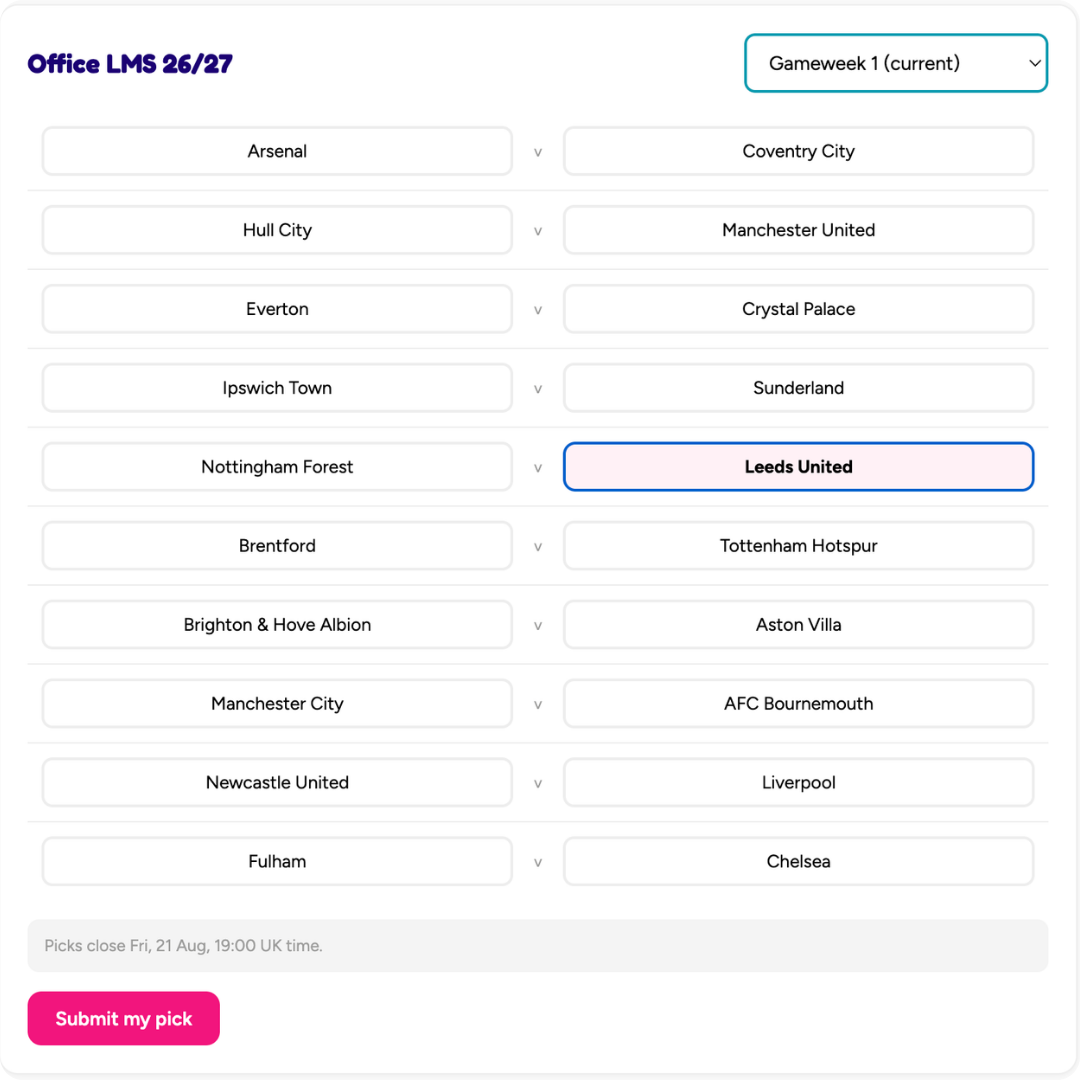
This works especially well around the premier league games. Each week, everyone picks one team they think won’t lose their game, without repeating a team across the season. Get it wrong and you're out. It runs for months and creates a slow-build tension that a one-off quiz can't match.
We have created a free Last Man Standing game which you can use to run your game. This tracks fixtures and eliminations automatically. You just need to get people to sign up.
Score Predictor
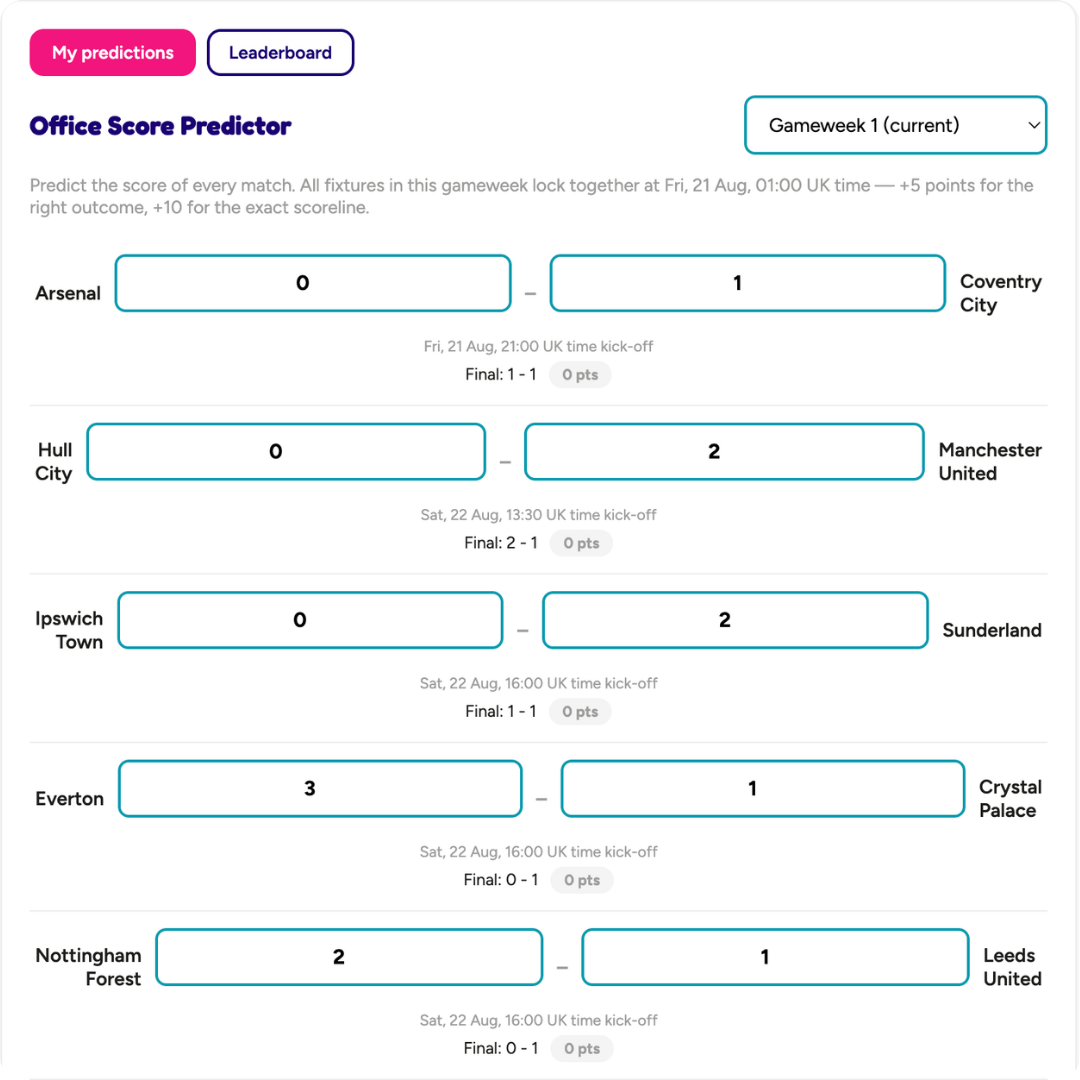
Lower stakes than Last Man Standing but more forgiving. Everyone predicts scorelines for the week and accumulates points for correct outcomes (5 points) and exact scores (10 points). It rewards people who follow football closely without eliminating the casual players in week two.
Our premier league score predictor game handles the scoring for you, gameweek by gameweek.
Wordle competition
Screenshot your daily result into a shared channel. Costs nothing, takes thirty seconds a day, and creates a durable habit loop. A lot of teams that run this find it outlasts almost every other engagement idea they've tried.
Book club
Old-fashioned, but it's one of the few recurring formats that gets people talking about something other than work, on a predictable monthly rhythm.
Team building activities that need more planning
When you've got a budget, a date on the calendar, and a bit of lead time, these are worth the effort.
Traitors
Based on the TV show: a handful of secret "traitors" try to eliminate the rest of the group without getting caught, while everyone else votes someone out each round. It requires a facilitator and a bit of structure to run, or you can book a dedicated Traitors experience in London.
Cocktail-making class
Fun, sociable, and works whether people know each other well or not.
Codenames
A real test of how well you understand your teammates. You're trying to get your partner to guess words based on one-word clues, without triggering the "assassin" word. You have to split into teams, which makes it good for larger groups or full departments.
Photo scavenger hunt
Send teams out with a list of specific shots to recreate within a determined amount of time, "recreate a scene from an iconic film in a library," for example. Takes some planning to write a good list, but it’s free and makes people run around the city.
What office organisers actually told us about running these games
We interview a lot of the people who end up running these games inside their companies. A few interesting insights came up that most team building advice doesn't mention.
Games with food attached get people back in the building. Several organisers were clear that these competitions weren't really about the prize money. They were a reason to get a hybrid team physically together. One team timed their bake-off entries so people brought food in and others came in to eat it, deliberately using the game to counteract the way hybrid work had quietly killed casual office contact.
Visible numbers create momentum. Organisers told us that showing how many people have already joined a game, not how much money is involved, just headcount, makes new people more likely to join in too. If you're launching a game, make the growing participant list visible.
Competitive games fill a gap that scheduled social events don't. One organiser ran a World Cup sweepstake in a 60-person office that already had a social committee and a quarterly pub quiz. A spontaneous, competitive game scratches a different itch than a planned social calendar does. Recurring games and one-off socials aren't competing for the same need. They solve two different problems.
How to pick the right game for your team
If you want something for a single meeting or event, pull from the quick icebreaker list. If you want something that keeps people checking a leaderboard for months with almost no ongoing effort from you, Last Man Standing or a score predictor game are the best. If you have a budget and a date locked in, save Traitors or a photo scavenger hunt for that.
Ready to run one?
Set up a season-long game your whole office can join in minutes. No spreadsheets, no chasing payments, no admin beyond sharing a link.



.jpg)


.png)